



Best Ventilation Solution for Damp and Mould
Find the best ventilation solution for damp and mould, from extractor fans to heat recovery, with practical advice for healthier Irish homes every day.


A bathroom mirror that stays steamed for hours, black spotting around window reveals and a bedroom that feels stuffy by morning are not small inconveniences. They are signs that moist, stale air is not leaving the flat fast enough. The best ventilation system for flats is the one that removes pollution and humidity where they are produced, brings in fresh filtered air, and suits the building without creating unnecessary heat loss or disruptive building work.
For many flat owners and landlords, there is no single off-the-shelf answer. A compact one-bed flat with recurring bathroom mould needs a different approach from a new-build block with ductwork already in place. The right choice depends on the layout, occupancy, insulation levels, existing ventilation routes and whether a whole-property or room-by-room solution is practical.
Mould is often treated as a cleaning problem. In reality, it is usually a moisture and airflow problem. Everyday living produces a surprising amount of water vapour through showering, cooking, drying clothes and sleeping. When that humid air reaches colder surfaces, condensation forms. Repeated condensation creates the conditions mould needs to grow.
Opening windows can help, but it is rarely a dependable year-round strategy. Windows are often kept shut during cold, wet or noisy weather, and window ventilation does not provide controlled extraction from bathrooms, kitchens or utility areas. A system should work consistently whether the property is occupied, empty for a few days or being managed by a landlord.
Before selecting equipment, establish whether the issue is condensation, a plumbing leak, penetrating damp or a combination of factors. A ventilation survey and indoor air quality assessment can identify poor extraction rates, blocked ducts, inadequate background ventilation and rooms where humidity remains high after normal use. Installing a larger fan without addressing a failed duct run or an air path through the flat can leave the original problem untouched.
Continuous mechanical extract ventilation, often called MEV, uses low-energy fans to extract air continuously from wet rooms such as bathrooms, kitchens and utility spaces. Fresh air enters through designed background vents or other planned air inlets in living rooms and bedrooms. The system can increase to a boost rate when someone showers or cooks.
This is a strong option where duct routes can serve several rooms and there is a suitable discharge point to outside. It provides predictable moisture removal without relying on occupants to switch a fan on. In an existing flat, however, installing new ductwork can be difficult where ceilings are concrete, service risers are inaccessible or the building has strict management rules.
MEV does not recover heat from extracted air. That is not automatically a reason to reject it, particularly in a practical retrofit where the priority is reliable humidity control. It does mean that well-designed fresh air supply and careful commissioning are essential, especially in airtight homes.
A centralised mechanical ventilation with heat recovery system, commonly known as MVHR, supplies filtered fresh air to bedrooms and living spaces while extracting stale, humid air from bathrooms, kitchens and utility rooms. The heat exchanger transfers much of the warmth from outgoing air to incoming air without mixing the two air streams.
For a new-build flat, major refurbishment or a property with accessible ceiling voids, MVHR is often the best long-term answer. It offers balanced ventilation, filtration and lower heat loss than extract-only systems. It can improve comfort near busy roads by allowing windows to remain closed while fresh air is supplied mechanically.
The trade-off is planning. Centralised MVHR needs space for the unit, a properly designed duct layout, access for maintenance and careful airflow balancing. Poorly installed ductwork can create noise, wasted energy and uneven airflow. It is not a fit-and-forget appliance. Filters must be checked and replaced, and the system needs to be commissioned so each room receives the intended airflow.
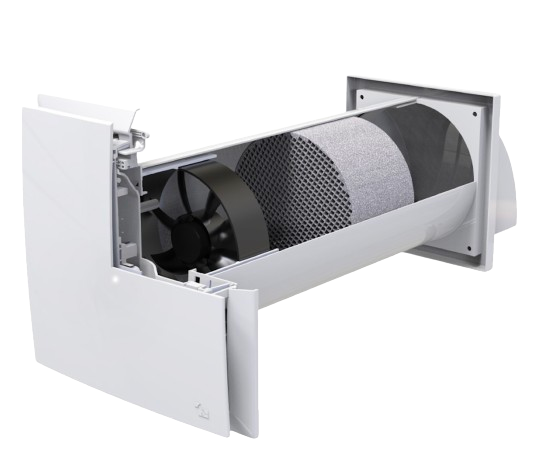
Single-room heat recovery ventilation units are particularly useful in existing flats where running a full duct network is not realistic. A compact unit is fitted through an external wall and alternates or balances supply and extract through a heat exchange core, depending on the model and configuration. Some systems can be installed as paired units to provide more balanced airflow across the home.
These units are well suited to a mould-prone bedroom, living room or small flat that lacks practical duct routes. They can bring filtered fresh air into the space while reducing the heat penalty associated with opening windows. They are also less intrusive than a whole-flat installation, as core drilling through an external wall is usually the main building work required.
Their limitations should be understood. A single unit will not automatically solve moisture generated in an internal bathroom or kitchen with no extraction route. It works best as part of a considered strategy, often alongside effective local extraction. Positioning also matters: the external wall location, noise level, weather exposure and access for servicing should be reviewed before installation.
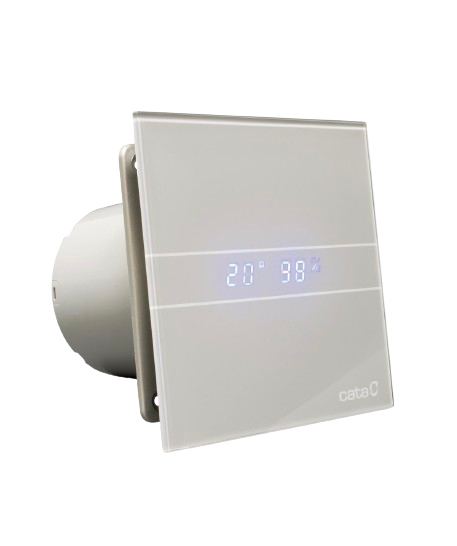
An intermittent extractor fan runs when the light is switched on, when a humidity sensor detects moisture, or via a timer. It is the most familiar option and can be very effective for a specific bathroom, ensuite, kitchen or utility room when installed correctly.
For a straightforward local issue, an extractor fan with humidity control and an appropriate overrun period may be all that is needed. The fan must be correctly sized for the room and duct length, and it must discharge outside rather than into a ceiling void. Long flexible ducts, crushed ducting, backdraught problems and clogged grilles can greatly reduce performance.
Extractor fans are usually the most affordable starting point, but they are not normally a whole-home ventilation strategy. They remove air from one area only and rely on replacement air being able to enter the property. In flats with persistent condensation in several rooms, a fan-only approach may treat the symptom while leaving bedrooms and living areas under-ventilated.
The first decision is whether the problem is local or property-wide. If one ensuite has poor extraction but the rest of the flat is dry and fresh, a quality extractor fan and duct upgrade can be appropriate. If condensation appears on multiple windows, occupants report stale bedrooms and mould returns in corners, a more comprehensive solution deserves consideration.
Next, look at the building fabric and available routes. Centralised MVHR is easiest where ducting can be planned from the outset. In a finished flat with solid ceilings and limited service space, decentralised heat recovery or improved extract ventilation can offer better value with less disruption. External-wall permissions may be required in managed blocks, particularly where the façade appearance changes.
Noise is another practical consideration. A system that residents switch off because it hums at night cannot protect indoor air quality. Select suitable equipment, use appropriate duct sizes and routes, and ensure the installation is designed to minimise vibration and air noise. Correct commissioning is as valuable as the fan or heat recovery unit itself.
Finally, think about who will maintain the system. Tenants and homeowners should be able to access filters, grilles and controls without difficulty. Property managers should have a clear record of installed equipment, maintenance requirements and airflow test results. Simple, visible controls encourage consistent use.
Ventilation performance is measured in airflow, not by how powerful a fan sounds. In Ireland, residential work should be considered against Technical Guidance Document F, including TGD F 2022, alongside the specific circumstances of the building and project. New-build, renovation and replacement work can have different requirements.
A compliant outcome requires more than purchasing a labelled product. Duct lengths, bends, terminals, room usage, air transfer paths and background ventilation all affect the final result. Once installed, airflow testing and balancing confirm whether the system is actually extracting and supplying the required volumes. Certification and reporting provide reassurance for homeowners and a useful record for landlords, developers and building managers.
PureAir Solution can supply, install, commission and certify flat ventilation systems nationwide, from a single mould-prone room to larger multi-unit projects. That joined-up approach avoids the common gap between buying equipment and proving that it performs as designed.
Even the best system benefits from sensible daily use. Keep supply and extract grilles clear of furniture, do not disable continuous fans, and clean accessible grilles as recommended. Use kitchen extraction while cooking and close the bathroom door after showering so moist air is directed towards the extract point rather than spreading through the flat.
Avoid drying laundry indoors without adequate ventilation. If this cannot be avoided, use the system’s boost setting and keep the drying area ventilated. Check filters at the stated intervals, particularly in urban locations where airborne dust can build up more quickly.
The most effective flat ventilation is not necessarily the largest or most expensive system. It is the one designed around the flat, installed with care and tested to deliver the airflow residents need. A professional assessment turns recurring condensation and mould from a frustrating cycle into a clear, practical plan for cleaner air and a healthier home.
Find the best ventilation solution for damp and mould, from extractor fans to heat recovery, with practical advice for healthier Irish homes every day.

Learn how a smart extractor fan helps prevent bathroom mould by responding to humidity, clearing damp air and protecting your home, health and finishes.

Core drilling for air conditioning & portable AC wall ports: clean, weatherproof openings for safer cooling, correct sizing and professional installation.